

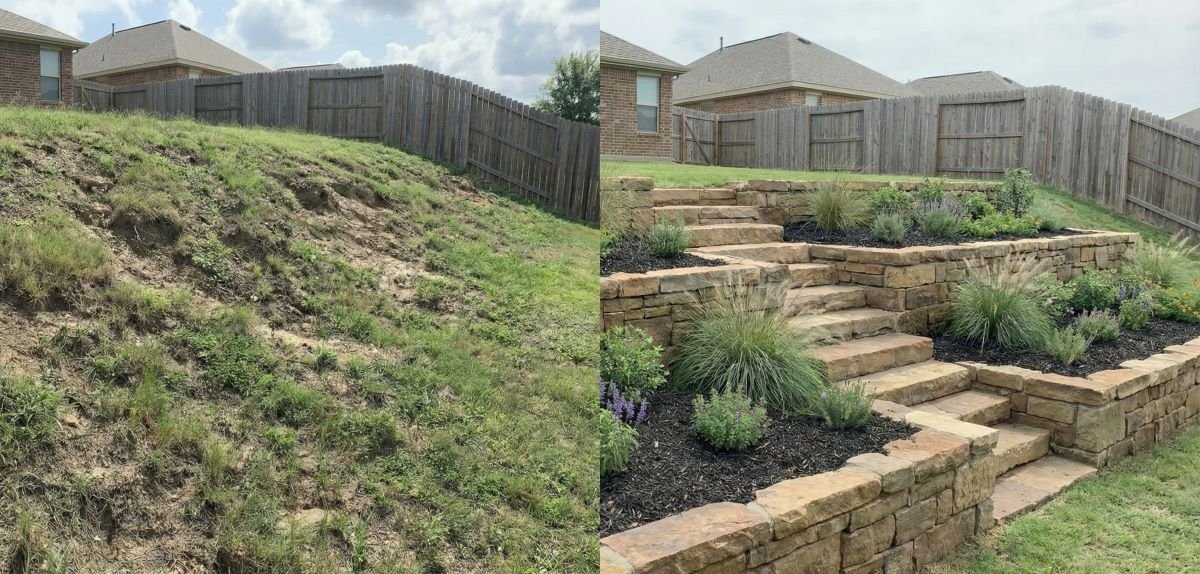

Sloped yards present unique challenges—erosion after heavy rains, difficult mowing, limited usable space, and plants struggling to establish on unstable ground. Yet many College Station – Bryan, TX properties feature significant slopes that homeowners either ignore or fight unsuccessfully, wasting money on solutions unsuited to Texas conditions.
The key to successful sloped yard landscaping is working with the slope rather than against it, using techniques and plants proven to perform in the Brazos Valley’s clay soils and weather extremes. Here’s what Dickerson Landscaping has learned designing functional, beautiful landscapes for sloped properties throughout the region.
Understanding Your Slope’s Characteristics
Not all slopes behave the same way. Understanding your specific situation guides appropriate landscape design choices.
Critical slope factors:
Slope angle determines what’s possible. Gentle slopes (under 15%) suit most approaches, while steep slopes (over 30%) require specialized techniques like terracing or extensive stonemasonry.
Sun exposure varies dramatically on slopes—south-facing slopes get intense afternoon sun and heat, while north-facing slopes remain cooler and shadier affecting plant choices.
Drainage patterns during Texas thunderstorms reveal where water concentrates, creating erosion channels or saturated zones needing drainage solutions.
Soil depth and quality often varies across slopes—hilltops may have thin, rocky soil while lower areas accumulate deeper, richer deposits.
Existing vegetation on College Station properties sometimes stabilizes slopes effectively, requiring landscape design that preserves beneficial plants while adding improvements.
Professional grading services can assess slope characteristics accurately, identifying both challenges and opportunities before you invest in solutions.
Terracing: Creating Level Spaces on Slopes
Terracing transforms steep, unusable slopes into multiple functional levels—the single most effective approach for severe grade changes.
Terracing benefits for sloped yards:
Creates level planting areas where plants establish more easily than on steep angles, with better water retention and reduced erosion.
Provides usable outdoor spaces for patio installation, gardens, or lawn areas that would be impossible on the original slope.
Controls erosion by breaking long slopes into shorter segments where water slows and infiltrates rather than rushing downhill.
Adds visual interest through elevation changes creating dynamic landscape design rather than monotonous flat yards.
Stonemasonry retaining walls supporting terraces deliver permanent solutions handling Brazos Valley clay soil movement and heavy rains. Natural stone landscaping or modular block systems both work well depending on aesthetic preferences and budget.
Dickerson Landscaping designs terraced solutions maximizing usable space while ensuring structural integrity and proper drainage throughout Bryan properties.
Strategic Grading and Drainage Solutions
Sometimes slopes don’t need elimination—they need better management through strategic grading and drainage solutions.
Grading approaches for sloped yards:
Subtle regrading can reduce severe slopes to more manageable angles without extensive terracing. Professional grading services redistribute soil creating gentler grades easier to landscape and maintain.
Swales and berms redirect water flow preventing erosion while creating planting opportunities. These earthwork features work with natural drainage rather than requiring expensive underground systems.
French drains and other drainage solutions capture and redirect water from problem areas, protecting slopes from saturation that causes slumping and erosion.
Surface stabilization through proper grading techniques prevents the washouts common after heavy Texas storms, protecting both slopes and downstream areas.
Combined with appropriate plant selection, good grading often solves slope problems without major structural work.
Plant Selection for Slope Stabilization
The right plants transform unstable slopes into stabilized, attractive landscapes while wrong choices waste money as plants wash away or fail to establish.
Effective slope plants for local conditions:
Deep-rooted groundcovers like Asian jasmine, liriope, or monkey grass spread quickly creating erosion-resistant mats that hold soil during storms. These require less water than lawn once established.
Native grasses including Gulf muhly, inland sea oats, and little bluestem develop extensive root systems stabilizing soil while handling Texas heat and drought.
Shrubs with fibrous roots such as nandina, yaupon holly, and possumhaw provide structure while their root masses bind soil effectively.
Erosion control plantings establish faster when combined with erosion control fabric or mulch, giving roots time to develop before heavy rains test stability.
Avoid sod installation on steep slopes—grass struggles on angles over 15-20%, requires constant mowing on dangerous terrain, and provides minimal erosion control compared to deeper-rooted alternatives.
Xeriscaping principles work beautifully on slopes, using drought-tolerant natives requiring less irrigation than traditional lawn landscaping while offering superior erosion resistance.
Hardscape Features for Sloped Properties
Hardscapes serve functional roles on slopes beyond aesthetics—providing access, controlling erosion, and creating usable spaces.
Strategic hardscape applications:
Stepping stone paths or stone stairs provide safe access up and down slopes while creating visual interest and preventing foot traffic from wearing erosion channels.
Retaining walls using stonemasonry or modular blocks create the terraces discussed earlier, turning liabilities into assets through level planting areas and gathering spaces.
Rock gardens work naturally on slopes, using boulders and stone landscaping to slow water, prevent erosion, and create low-maintenance beauty suited to Texas conditions.
Hardscape curb appeal features like stone-edged beds define spaces while preventing mulch and soil from washing downhill during storms.
Patio installation on slopes requires careful site preparation and often benefits from professional grading creating level foundations that won’t shift over time.
Lawn Care and Maintenance Considerations
Sloped yards with lawn areas create ongoing maintenance challenges many homeowners underestimate during initial landscape design.
Slope lawn realities:
Mowing slopes steeper than 15% creates safety hazards, with mowers potentially tipping or operators losing footing. Professional lawn care services often refuse steep slopes or charge premium rates.
Irrigation on slopes wastes water as runoff occurs before soil can absorb moisture. Sprinkler & irrigation systems need careful design with shorter run times and potentially drip systems for better efficiency.
Grass struggles on slopes in Brazos Valley clay soils, especially during summer stress. Bare patches develop easily and erosion follows quickly.
Consider whether lawn on slopes truly makes sense versus groundcovers, xeriscaping, or hardscapes offering easier maintenance and better erosion control.
Landscape maintenance for sloped properties often costs more than flat yards due to access challenges and specialized equipment needs.
Combining Strategies for Complete Solutions
The most successful sloped yard transformations combine multiple approaches rather than relying on single solutions.
Integrated design examples:
Upper slopes might feature xeriscaping with drought-tolerant natives and stone landscaping, requiring minimal irrigation while controlling erosion effectively.
Mid-slope terracing could create level areas for patio installation or small lawn spaces, supported by stonemasonry walls.
Lower slopes might transition to softer landscapes with flowering beds, mulch, and tree landscaping in areas where water naturally accumulates.
Throughout, strategic grading and drainage solutions ensure water moves safely through the property without causing erosion or flooding problems.
Outdoor Christmas lighting, paths, and other amenities integrate into the comprehensive landscape design & installation creating beautiful, functional outdoor spaces.
Transform Your Sloped Property
Sloped yards aren’t landscaping failures—they’re opportunities for distinctive, dramatic landscapes impossible on flat lots. The key is professional landscape design embracing slopes rather than fighting them.
Whether your College Station property features gentle grades or steep hillsides, solutions exist creating beautiful, functional outdoor spaces while controlling erosion and reducing maintenance demands.
Dickerson Landscaping, LLC specializes in sloped yard challenges throughout Bryan, College Station, and the Brazos Valley. Our expertise in grading services, drainage solutions, stonemasonry, and slope-appropriate planting creates landscapes that work with your property’s topography.
Ready to transform your sloped yard? Call (979) 282-3469 to discuss landscape design solutions perfectly suited to your property’s unique characteristics.