

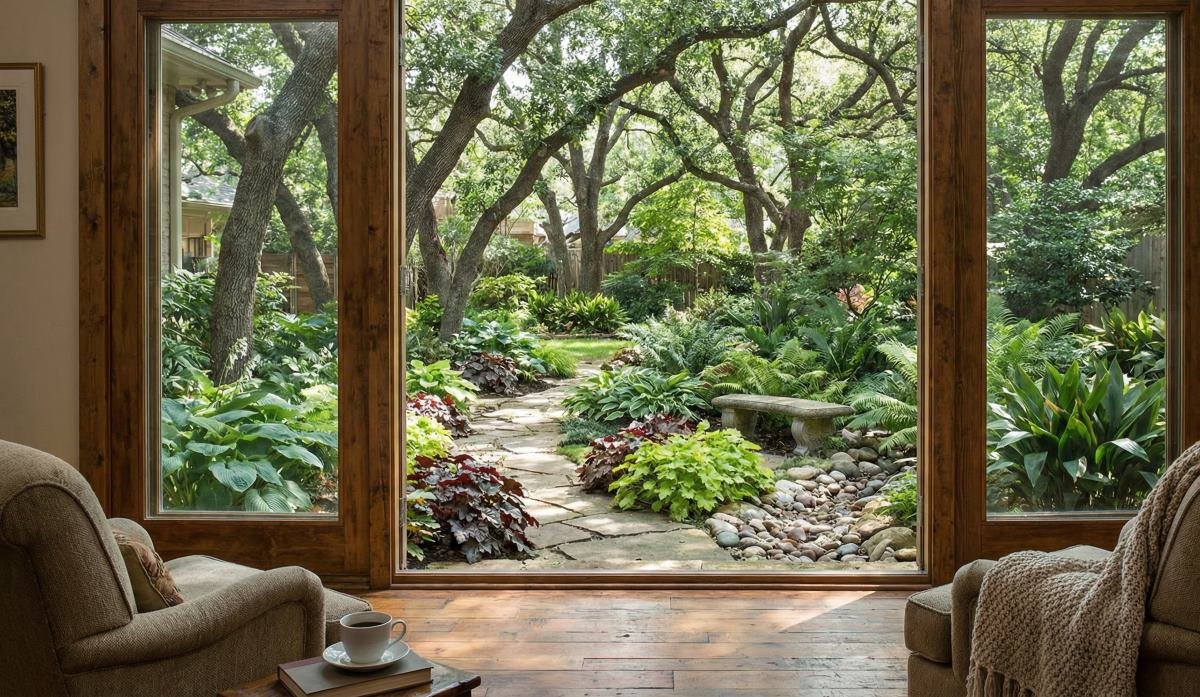

Mature trees create beautiful canopies providing welcome relief from Texas heat, but they also present landscaping challenges that frustrate College Station – Bryan, TX homeowners. Shade kills sun-loving grass, tree roots compete with other plants, and many traditional landscape choices simply won’t thrive under dense canopy cover.
The good news? Shade isn’t a landscaping limitation—it’s an opportunity to create lush, distinctive gardens that actually require less water and maintenance than sun-drenched areas. Here’s how Dickerson Landscaping approaches shade landscaping for tree-covered yards throughout the Brazos Valley.
Understanding Different Types of Shade
Not all shade affects plants equally. Understanding shade variations helps you choose appropriate plants and design strategies for specific areas under your trees.
Shade types in tree-covered yards:
Dappled shade occurs under trees with open canopies allowing filtered sunlight throughout the day. Many plants thrive here, making it the easiest shade condition for landscaping.
Partial shade means areas receive direct sun part of the day (typically 3-6 hours) and shade the remainder. Morning sun locations suit more plants than afternoon sun spots, as Texas afternoon heat stresses even shade-lovers.
Full shade describes dense canopy cover blocking direct sunlight completely. These challenging areas require careful plant selection focusing on true shade-tolerant species.
Dry shade under large trees like oaks combines low light with root competition for moisture—the most difficult landscaping condition requiring specialized plants and soil amendments.
Identifying which shade type exists in different yard areas guides appropriate plant choices for your Brazos Valley property.
Shade-Loving Plants for Bryan-College Station
Texas shade gardens thrive when planted with species adapted to both low light and local climate. These plants handle shade while tolerating Bryan’s heat, humidity, and occasional drought.
Excellent shade plants for tree-covered yards:
Ferns including autumn fern, holly fern, and wood fern provide lush texture thriving in Texas shade. They tolerate dry conditions once established and offer year-round interest.
Hostas grow beautifully in Brazos Valley shade, offering varied foliage colors and textures. Choose heat-tolerant varieties suited to Southern gardens rather than northern cultivars.
Cast iron plant (Aspidistra) earns its name by surviving neglect, deep shade, and tree root competition—perfect for challenging spots.
Ajuga serves as excellent groundcover spreading beneath trees where grass won’t grow, offering spring flowers and evergreen foliage.
Turk’s cap provides red or pink blooms in shade, attracting hummingbirds while handling Texas heat and humidity excellently.
Liriope forms neat borders with grasslike foliage and purple flower spikes, tolerating both shade and drought once established.
Coral bells (Heuchera) offer colorful foliage in burgundy, lime, or purple, performing well in College Station shade when given adequate moisture.
Dickerson Landscaping selects plants proven to perform in local conditions rather than those that merely tolerate shade but struggle with Texas climate extremes.
Dealing with Tree Roots
Tree roots present physical challenges for shade landscaping—they compete for water and nutrients, create uneven surfaces, and make digging difficult. Smart design works around these realities rather than fighting them.
Root-friendly landscaping strategies:
- Raised beds built above root zones rather than excavating through them
- Container gardens providing growing space without disturbing tree roots
- Mulch expansion accepting that some areas won’t support plants
- Surface-rooting plants that don’t require deep planting holes
- Tree health protection avoiding root damage that stresses mature trees
Never remove large tree roots to accommodate landscaping—you’ll damage the tree far more than you’ll help your garden. Instead, work with existing root structures using shallow-rooted plants and creative design.
For Bryan-College Station yards with established oak, pecan, or pine trees, respecting root systems ensures both tree health and landscape success.
Design Ideas for Shaded Spaces
Shade creates opportunities for landscape features that would struggle in full sun. These design elements transform tree-covered yards from challenging spaces into distinctive outdoor rooms.
Shade garden design concepts:
Layered plantings using varied heights create depth and interest. Tall ferns backed by medium hostas fronted by low ajuga builds visual complexity.
Texture emphasis becomes crucial when color options narrow. Combine fine-textured ferns with bold hostas and strappy liriope for contrast.
Foliage color provides interest without relying on flowers. Mix chartreuse coral bells with burgundy heuchera and green cast iron plant.
Naturalistic designs embracing woodland character suit shade better than formal styles. Curved bed edges and organic groupings feel appropriate under trees.
Hardscaping integration expands usable space where plants won’t thrive. Patios, pathways, and seating areas work beautifully in shade.
Lighting addition extends evening enjoyment while highlighting interesting tree trunks and foliage textures after dark.
College Station properties with mature tree cover often benefit from accepting shade as an asset rather than fighting it—creating cool, inviting spaces that contrast with sun-exposed areas.
Soil Improvement for Shade Success
Trees create challenging soil conditions through root competition and leaf accumulation. Improving soil quality helps shade plants establish and thrive despite these challenges.
Soil amendments for shade gardens:
- Organic matter addition through compost improving moisture retention and fertility
- Mulch application (2-3 inches) moderating temperature and suppressing weeds
- Leaf incorporation using fallen tree leaves as natural mulch and soil amendment
- Careful fertilization providing nutrients without excessive root competition
- pH adjustment if needed, as some trees acidify soil over time
Avoid piling soil against tree trunks when building beds—this encourages rot and disease. Maintain the original soil grade around trunks while improving surrounding areas.
Brazos Valley’s clay soils particularly benefit from organic matter additions, creating better conditions for shade plant roots navigating between tree roots.
Watering Strategies for Tree-Covered Areas
Shade reduces water needs compared to sun, but tree roots compete for available moisture. Smart watering ensures both trees and understory plants thrive.
Effective shade garden watering:
- Drip irrigation delivering water precisely where plants need it
- Deep watering encouraging plant roots to grow below tree root competition
- Morning watering allowing foliage to dry, reducing fungal disease risk
- Mulch maintenance conserving moisture and reducing watering frequency
- Drought-tolerant plant emphasis minimizing water needs in dry shade
Trees receive most available moisture, so shade plants must tolerate periodic dryness even when growing in low light. Choosing drought-tough species prevents constant watering demands.
Embracing Shade as an Asset
Tree-covered yards in Bryan-College Station offer advantages that sun-drenched properties lack—natural cooling reducing energy costs, established character from mature trees, and opportunities for distinctive shade gardens impossible in full sun.
Rather than viewing shade as a problem requiring solutions, embrace it as an asset enabling different landscape styles. Shade gardens require less water than lawns, feature fewer pest problems, and often demand less maintenance once established.
Dickerson Landscaping, LLC helps Brazos Valley homeowners transform challenging shaded spaces into beautiful, functional gardens. We understand which plants perform locally, how to work around tree roots without damaging them, and design strategies that make shade an advantage rather than limitation.
Ready to create a beautiful landscape under your trees? Call (979) 282-3469 to discuss shade landscaping options for your tree-covered yard.